WP OneTap”Accessibility Widget Mirrors accessiBe’s Discredited Claims
In April 2025, the Federal Trade Commission (FTC) took enforcement action against accessiBe Inc. and accessiBe Ltd., ordering the companies to pay one million dollars for deceptive claims that their accessibility widget could make any website fully compliant with accessibility standards. The FTC complaint (File No. 2223156) describes how accessiBe’s accessWidget failed to correct essential accessibility barriers, introduced new ones, and misled customers into believing it could achieve full WCAG compliance within forty-eight hours.
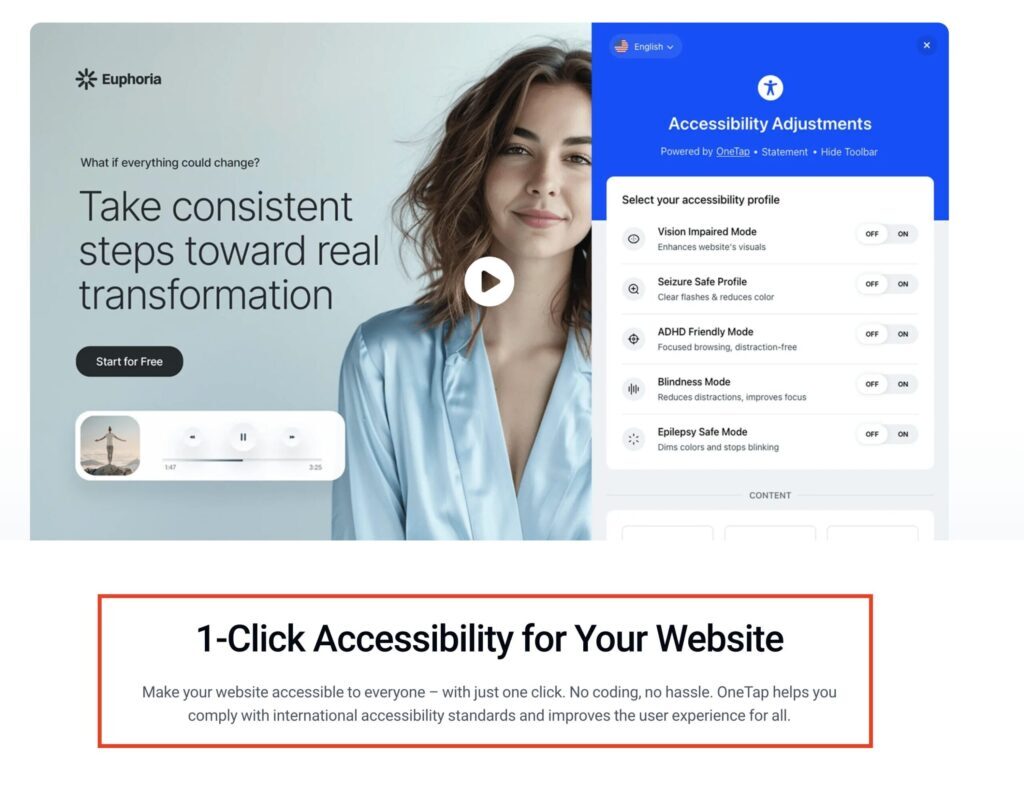 A similar issue is now spreading through the WPOneTap accessibility plugin, which is available in the WordPress repository. WPOneTap is being installed on numerous public library websites. Its marketing language closely mirrors accessiBe’s false claims, promising “one click accessibility,” “instant WCAG and ADA compliance,” and “no coding required.”
A review of WPOneTap’s website shows nearly identical statements to those found in the FTC’s complaint against accessiBe, suggesting that WPOneTap follows the same misleading approach and makes unverifiable compliance assurances.
Technical Failures and Accessibility Risks
Due to WPOneTap’s very poor coding, it automatically introduces new accessibility barriers to any websites that use them.
- It adds approximately thirty-five focusable elements to every page, forcing screen reader users and people who rely on keyboard navigation to move through repetitive and irrelevant buttons on every page.
- The widget receives keyboard focus while hidden, violating WCAG 2.1 Success Criteria 2.4.3 (Focus Order) and 2.1.1 (Keyboard Accessibility).
- The widget uses input labels that do not reference unique input ids, breaking the programmatic association between labels and controls. This violates WCAG 2.1 Success Criterion 1.3.1 Info and Relationships.
- It creates multiple WCAG failures, making any website that installs it non-compliant with WCAG 2.1 and in violation of ADA Title II.
These issues directly affect usability for people with disabilities, making navigation more confusing, time consuming, and error prone. For public libraries, this means the plugin does the opposite of what it promises: it reduces accessibility and increases legal and ethical risk.
A Critical Reminder for All Website Owners
Accessibility cannot be achieved through automation or one click solutions. Public libraries must perform proper due diligence and ensure that their accessibility providers conduct manual testing using assistive technologies and documented WCAG evaluations.
Installing WPOneTap or any similar automated overlay makes a website not accessible, not WCAG compliant, and noncompliant with federal accessibility law. True accessibility requires clean code, verified testing, and continuous maintenance, not automated promises.
The National Federation of the Blind has taken a clear position against accessibility overlays and widgets, citing their negative impact on blind users and overall access. (https://nfb.org/programs-services/advocacy/policy-statements/comments-federal-trade-commission-regarding-accessibe)
The International Association of Accessibility Professionals advises organizations not to rely on accessibility widgets or plugins as a shortcut to real accessibility. (https://www.accessibilityassociation.org/overlay-position-and-recommendations)